Blog Details
- Home
- Blog Details



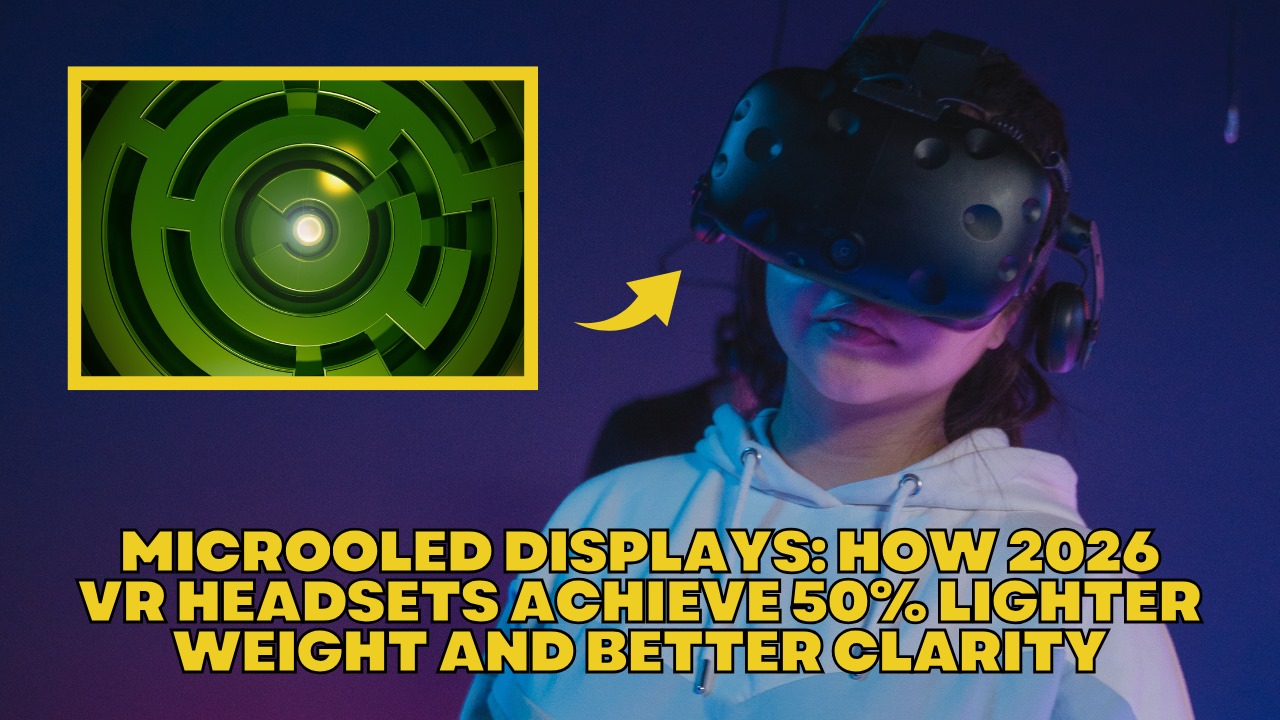
MicroOLED display technology is redefining the future of virtual reality by enabling lighter, sharper, and more energy-efficient VR headsets. As VR market demand continues to rise in 2026, companies are shifting from bulky Fresnel-lens designs to slim, high-density MicroOLED panels that drastically reduce weight while delivering crystal-clear visuals. This breakthrough paves the way for next-generation enterprise and consumer VR solutions that prioritize comfort, immersion, and long-term usability.
The VR industry has reached a turning point. After years of bulky headsets, limited clarity, and heavy optical systems, 2026 marks a new era powered by MicroOLED displays. These ultra-compact panels pack millions of pixels into a thumbnail-sized screen, enabling VR manufacturers to design headsets that are up to 50% lighter, dramatically clearer, and significantly more power-efficient. For VR Labs Studio and its clients, this revolution opens the door to more immersive training, real estate visualization, design simulation, and enterprise-grade experiences without the physical strain traditionally associated with VR hardware.
MicroOLED, also known as OLED-on-Silicon, is a display technology that integrates OLED pixels directly onto a silicon backplane instead of using traditional glass substrates. This allows the creation of incredibly small, dense, and bright displays with pixel densities far beyond conventional screens. Because MicroOLED panels are extremely compact, they reduce the need for bulky lenses and offer exceptional brightness, sharpness, and contrast making them ideal for next-generation VR and AR headsets.
Integrating MicroOLED technology into 2026 VR headsets requires alignment between display engineers, optics designers, and thermal management specialists. Manufacturers must redesign lens systems often transitioning to pancake or holographic optics to fully leverage the compact nature of MicroOLED panels.
However, challenges persist. MicroOLED production costs remain higher than traditional panels, and maintaining extremely high pixel density without defects requires precision manufacturing. Brightness levels, while impressive, must be balanced to avoid color shift or reduced panel lifetime. Heat dissipation in high-brightness modes also requires advanced cooling materials. Despite these challenges, rapid industry adoption and improved production yield are driving widespread deployment across consumer and professional VR markets.
MicroOLED displays are shaping the future of VR in 2026 and beyond. By delivering lighter, sharper, and more power-efficient headsets, this technology removes long-standing barriers to comfort and immersion. Whether used for enterprise training, architectural VR tours, interactive gaming, or large-scale XR deployments, MicroOLED unlocks the next generation of high-performance virtual reality experiences. As VR Labs Studio continues to innovate in VR development, MicroOLED-powered headsets ensure our clients receive the most advanced, comfortable, and visually stunning solutions available in the industry.
